
Reading a Fragrance Timeline With a Trained Eye: Where the Weeks Really Go
A fragrance timeline is not a list of durations; it is a chain of dependencies, and most of the slippage in a direct-to-consumer launch happens where two dependencies meet rather than inside any single stage. A brand team with even basic perfumery training reads a schedule differently, because it understands what a sample round is actually waiting for and which stages cannot start until a formula is frozen. The result is a plan built backwards from a launch date, with the fragile joints identified before the date is announced.
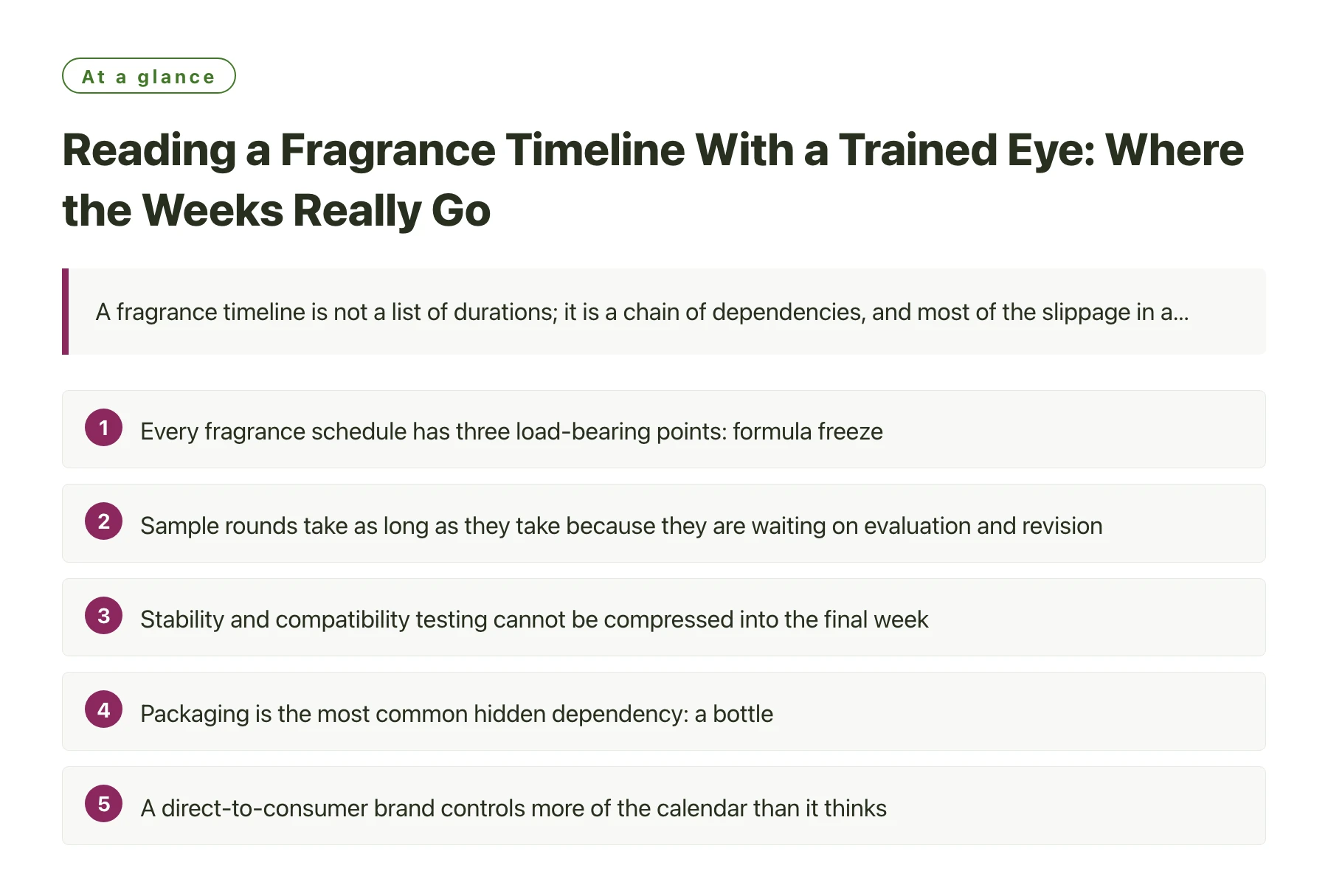
Key takeawaysEvery fragrance schedule has three load-bearing points: formula freeze, bulk approval and packaging readiness, and a plan that does not name them is a wish list. · Sample rounds take as long as they take because they are waiting on evaluation and revision, not only on laboratory time, so the brand's own review speed is part of the critical path. · Stability and compatibility testing cannot be compressed into the final week, because it needs elapsed time at defined conditions and produces results when it produces them [1]. · Packaging is the most common hidden dependency: a bottle, pump or decoration lead time can sit behind the fragrance schedule and quietly set the launch date. · A direct-to-consumer brand controls more of the calendar than it thinks, because the approval decisions, the artwork sign-off and the reference confirmation are all internal tasks.
The first time a brand commissions a fragrance, the schedule arrives as a table: sampling, several weeks; bulk production, several weeks; filling and packing, a few more. It reads like a sequence of independent blocks. The second time, the same table is read as a dependency map, because the first launch taught the team that weeks do not disappear inside stages, they accumulate at the handovers.
This is where perfumery training pays off in a way that has nothing to do with smelling anything. Knowing what a perfumer does during a revision round, and what a testing window is measuring, turns a supplier's quoted duration into something a project manager can plan around and, where necessary, argue about.
What follows is how a trained team reads and rebuilds a fragrance schedule for a brand selling through its own channels.
Six moves for rebuilding a schedule backwards
- Fix the shelf date firstStart from the day stock has to be in the warehouse, not from the day the brief is sent, and subtract the shipping and quality release buffers before anything else.
- Place packaging on the same chartBottle, pump, cap, decoration and carton lead times belong on one timeline with the fragrance, because they are bought in parallel and any one of them can become the critical path.
- Name the formula freeze dateA formula that is still being revised cannot be tested, priced or labelled, so the freeze date is the point from which most downstream work is counted.
- Reserve the testing windowCompatibility and stability work needs elapsed calendar time at defined conditions, and it should be scheduled as a real period rather than as a formality at the end [1].
- Book the brand's own review slotsSample reviews, artwork approvals and reference sign-offs consume internal time, and teams that skip these slots discover that the factory was waiting on them.
- Add one controlled bufferKeep a single visible buffer at the handover between sample approval and bulk release rather than padding every stage, so the schedule stays honest and the buffer is spent deliberately.
Where the weeks actually go
| Stage | What sets its length | The usual point of slippage |
|---|---|---|
| Brief to first samples | Clarity of the brief, availability of matching materials and the number of directions requested | An incomplete brief that forces a second interpretation round |
| Sample evaluation and revision | How quickly the brand gives consolidated feedback, and how many directions remain open | Feedback arriving in three conflicting versions from four people |
| Formula freeze to testing | Elapsed time at defined conditions, plus laboratory queues | Testing started after the label artwork was already approved |
| Bulk compounding and fill | Order quantity, material availability and line scheduling at the factory | Packaging components arriving later than the fragrance compound |
| Decoration and assembly | Decoration method, drying or curing time, and second-pass quality checks | Decoration capacity booked late in the season alongside everyone else |
| Release and shipping | Documentation, inspection and the chosen freight mode | Compliance documents requested only once the goods were ready to move |
Read this way, the schedule becomes a set of conversations rather than a set of numbers. A brand team that understands the middle column can ask a supplier why a duration is what it is, and can compare two quotations honestly rather than comparing two guesses. It is also easier to see where a change of scope, such as adding a second product format, propagates through the whole calendar. The sequence above is the same one described in any the stages of perfume production walkthrough, and a supplier that can map it onto the brand's own dates without hesitation is usually one that has run it many times [2].
The stages that cannot be shortened
Two parts of a fragrance schedule resist compression. The first is testing, because stability and compatibility results are a function of elapsed time; a laboratory can start sooner, but it cannot finish sooner than the chemistry allows. The second is the evaluation loop, because a revision round needs a considered reaction from the brand before the perfumer can act on it.
That second constraint is the one teams overlook, and it is the one they control. Consolidating feedback into a single written response, with each direction marked as approve, adjust or drop, can remove a full revision round from a schedule without touching the factory at all. Training makes this easier because it gives a team the vocabulary to write that response precisely instead of asking for something vague to be made different.
It is worth having that conversation with more than one candidate before committing, because a schedule discussion reveals how a manufacturer thinks. A partner that can place every stage on a calendar, name what each stage waits for and answer questions about its own capacity is far easier to plan with than one that repeats a single duration. That is the kind of answer a brand should expect when it sits down with a manufacturer such as Xuelei Perfume, and it is the same conversation that makes the second order much less eventful than the first.
Reading a quoted lead time critically
When a supplier quotes a lead time, it is worth asking which stage the number covers and what it assumes. A figure for bulk production that begins at formula freeze is not comparable with a figure that begins at purchase order, and both are different again from a number that assumes packaging is already in the warehouse.
The productivity of that question is that it can be asked in writing at quotation stage without friction. A supplier that answers in stage terms is handing the brand a planning tool; one that repeats a single number without qualifying it is inviting a dispute later.
Sequencing a range rather than a product
Direct-to-consumer brands rarely launch a single item. A range of three or four products shares one brief and often one scent, but the formats have different testing needs and the packaging has different lead times. The efficient pattern is to lock the scent first, then run the formats in a defined order, with the hero product tested and approved ahead of the rest production capacity and lead times.
Running everything in parallel feels faster and usually is not, because it multiplies the decisions in flight at exactly the moment when the team has least capacity to make them.
The test of a good fragrance schedule is not whether it is short, but whether every date on it has a named dependency and an owner. A plan in that form survives a slipped sample round, a late bottle delivery and a change of launch channel, because the team can see what to move. A plan in the form of a quote survives nothing, and it is usually the brand rather than the factory that pays for the discovery. Building the dependency version takes an hour with the right partner at the table, and it is the version worth sharing with everyone who has to hit the date.
Sources
- SGS: Cosmetics, Personal Care & Household Testing —— Testing, inspection and certification services for cosmetics and personal care, including microbiological, stability and safety testing aligned with cosmetics GMP.
- Cosmetics Business —— A trade publication covering the beauty and cosmetics industry, including fragrance launches and regulatory developments.
Frequently asked questions
How long does a first private label fragrance project take?
It depends on how many directions are sampled, how fast the brand reviews them, whether testing runs in parallel and whether packaging is ready. A realistic plan separates those four dependencies and puts dates on each, rather than applying a single industry duration that assumes everything is available.
Can stability testing be skipped to save time?
Skipping it moves the risk rather than removing it. Without defined compatibility and stability work, a formula and package are being released on the assumption that they behave, and the failure shows up as a changed scent, a leaking pump or a claim that cannot be supported later.
Why does packaging often delay a fragrance launch?
Because it is purchased in parallel with the scent but manufactured on different lines, with decoration adding a second pass and a curing period. When the bottle, pump or carton arrives after the compound, the filling date moves even though the fragrance was never late.
What can a brand do to shorten the sampling stage?
Send one clear written brief, ask for a defined number of directions, and return consolidated feedback within an agreed window. Those three habits remove more time than any negotiation over the quoted duration of the sampling stage.
Should we plan for a buffer in the schedule?
Yes, but one visible buffer at the sample-to-bulk handover is more useful than padding every stage. A visible buffer can be spent deliberately when a specific problem appears, while hidden padding simply makes the whole plan look longer and hides where the risk actually sits.
Skip the scroll. Open the verified index.
Browse Verified Listings →